Theory

Understanding the Intention-Behavior Gap

The intention-behavior gap (IBG) is a fundamental challenge in health psychology. It refers to the disconnect between what people intend to do and what they actually end up doing. For example, many of us plan to exercise three times a week, but by the end of the week, we find we have only managed one session or none at all. This common gap between our intentions and actions highlights a significant issue in translating plans into behaviors. Despite our best intentions to exercise regularly, eat healthier, or manage stress better, we often find ourselves falling short. This gap reveals that intention alone is not always sufficient to produce action. Understanding this gap can help us bridge the divide between setting goals and making meaningful, sustained changes in our lives.

Why the Intention-Behavior Gap Matters

The IBG is crucial because it directly affects our health outcomes. Many chronic health conditions—such as heart disease, type 2 diabetes, and obesity—are linked to behaviors that we struggle to maintain despite good intentions. By understanding why the gap exists, we can design better strategies, interventions, and tools to transform our intentions into lasting behavior change. This understanding can empower us to create healthier routines and, ultimately, improve our overall well-being.

The Dynamic Nature of Intentions as the Key to Understanding the IBG

To understand the intention-behavior gap, we must first appreciate the dynamic nature of intentions. Intentions are not static; they change as our life circumstances change. Whether it is due to shifts in our work schedule, unexpected events, changes in our emotional state, or evolving priorities, intentions are inherently flexible. This dynamic quality is both a strength—allowing us to adapt – and a challenge – making it difficult to consistently translate intentions into actions.

One critical aspect of this dynamic nature is the temporal stability of intentions. Intentions that remain stable over time are more likely to lead to successful behavior enactment. However, when intentions fluctuate, the likelihood of following through decreases significantly. This instability often explains why our behavior deviates from our original plans. Therefore, understanding and enhancing the stability of intentions is a key part of bridging the intention-behavior gap.

Another important consideration is the proximity of intention and behavior. The closer in time an intention is to the actual behavior, the more likely it is that the behavior will occur. Intentions formed for actions that are to be taken in the near future are often more stable and actionable compared to those intended for distant future behaviors. This proximity effect means that short-term intentions, with a clear, immediate timeframe, are often more successful than long-term, abstract goals.

To better understand this concept, consider Figure 1, which illustrates three behavioral episodes for a periodic behavior (e.g., attending a weekly training course). Figure 1 provides a visual representation of how intentions develop and change over time in relation to the intended behavior.

First Behavioral Episode: Initially, the intention to attend the training session is very high, starting 7 days before the session. This high intention remains relatively stable for the next four days, but then drops off about three days before the training. In the last two days before the session, the intention is no longer present, indicating that the person has decided not to attend. Whether or not we observe an intention-behavior gap depends on when we measure the intention. If we measure it 4-7 days before the behavior, we observe a gap, as the intention was high at that point. However, if we measure the intention 1-2 days before the behavior, there is no gap—the individual’s actions align with their latest intentions.

Second Behavioral Episode: In this episode, the intention remains stable at a high level throughout the week. Regardless of when the intention is measured during the week, the outcome is the same: the person acts in line with their intention, and no intention-behavior gap is observed.

Third Behavioral Episode: Initially, the intention to attend the training is stable. However, one day before the actual behavior, the individual changes their mind and decides not to attend. In this scenario, an intention-behavior gap exists during the first five days of the episode. However, if the intention is measured one day before the behavior—or on the day itself—there is no gap, as the action aligns with the updated intention. In this sense, both the timing of the intention measurement and the stability of the intention are crucial parameters influencing the existence of the intention-behavior gap.
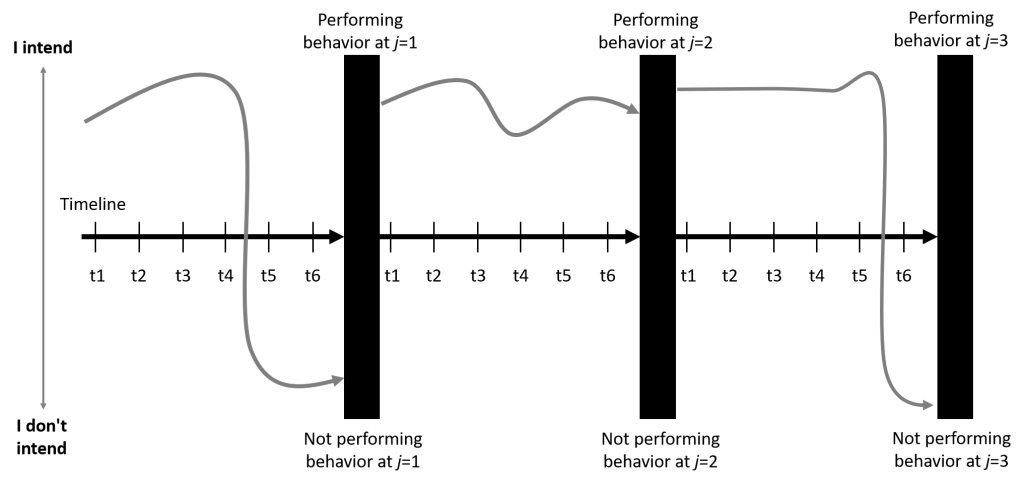
Figure 1: Development of intention in three behavioral episodes

Figure 1 illustrates the development of intentions over time across three distinct behavioral episodes, demonstrating how temporal stability, fluctuations, and proximity influence the intention-behavior gap. This visual representation provides a clearer understanding of how the dynamic nature of intentions impacts whether or not an individual follows through with their intended behavior. These insights highlight the importance of both the timing of intention formation and the subsequent stability of these intentions. By examining behavioral episodes in this way, researchers and practitioners can better identify the key factors that facilitate or hinder successful behavior enactment.

The Mathematical Representation of IBG

IBG represents the deviation between our intended behavior and our actual behavior and can be represented mathematically as:

Where:

  • I = Intended behavior
  • B = Observed (actual) behavior

This formula seems very simple and obvious, but it represents a radical departure from traditional ideas of IBG, which see it as a lack of correlation between intention and behavior. This redefinition of the IBG formula has serious implications for the methodology, study designs, and statistics used for the analysis of IBG. For example, study designs may need to shift from between-person analyses to within-person analyses to better capture the dynamic, individual-level variations in intention and behavior.

Four Dimensions of the Intention-Behavior Gap

Exploring the IBG means recognizing that our behaviors are influenced by multiple factors across four key dimensions: persons, time, context, and types of behavior.

  • Persons: This dimension reflects the inter-individual differences shaped by personality, motivation, and cognitive processes.
  • Time: The time dimension captures how intentions and behaviors can change over different timeframes, highlighting intra-individual variability.
  • Context: The context dimension considers the influence of different settings, such as work, home, or social environments, on the translation of intention into behavior.
  • Types of Behavior: This dimension refers to variations in IBG across different actions, such as exercising versus dietary choices, even within the same individual.

By addressing these four dimensions, we can better understand what keeps us from achieving our goals and, more importantly, how to overcome those barriers effectively.

Assumptions

Assumptions of the Intention-Behavior Gap Concept

To fully understand the concept of the IBG as a multidimensional difference, it is important to recognize the underlying assumptions that shape how we interpret and measure this gap. These assumptions provide the foundation for research and interventions aimed at closing the IBG and are critical for accurately conceptualizing and analyzing the gap between intention and behavior.

Conceptual Equivalence Between Intention and Behavior

The first assumption is that there is conceptual equivalence between intentions and behaviors. This means that what people intend to do should conceptually match the behavior that is eventually measured. However, intentions are often broad and general, such as intending to “be more active”, while behaviors are specific, context-driven actions like “running three times a week”. The misalignment between general intentions and specific actions is one reason the IBG arises, suggesting that precise alignment between intention and behavior definitions is necessary for accurate analysis.

Temporal Equivalence

Another assumption is temporal equivalence – that intentions and behaviors are evaluated over comparable timeframes. If someone forms an intention to exercise “in the future”, but the behavior is only measured for the next week, this creates a mismatch. Understanding the IBG requires that both intentions and behaviors are considered in equivalent temporal contexts, ensuring consistency between what is intended and what is assessed. This is particularly important in research settings to ensure that the timeframe for behavioral measurement aligns with the timeframe of the intended action.

Behavioral Episodes

The concept of behavioral episodes is also central to understanding the IBG. It assumes that behavior can be broken down into discrete episodes that can be analyzed individually. Each behavioral episode—such as going for a run, preparing a healthy meal, or attending a workout class—represents an instance of acting on an intention. The assumption here is that examining these episodes helps us understand specific moments where intentions either succeed or fail to translate into action. This episodic approach provides a detailed view of the dynamics involved in each attempt to execute an intention, rather than averaging behavior over a long period.

Continuous vs. Dichotomous Representation

Finally, there is an important assumption regarding the continuous versus dichotomous representation of behavior and intention. To accurately understand the IBG, it is crucial that both intention and behavior are represented in the same way—either dichotomously or continuously. Mixing these types of representations can lead to a misinterpretation of the IBG. The choice between dichotomous and continuous representation also has significant implications for the statistical methods used in analysis.

Methods

Understanding the intention-behavior gap has major implications for the research methodologies used to study this phenomenon. Traditional methods, often relying on cross-sectional studies, tend to overlook the dynamic nature of intentions and behaviors, resulting in gaps in our understanding of the factors influencing the IBG. To address these challenges, methodologies like Ecological Momentary Assessment and Mixed Methods Approaches provide promising alternatives that offer a more nuanced understanding of the IBG, including the ability to consider all four dimensions of the IBG.

Ecological Momentary Assessment

Ecological Momentary Assessment (EMA) is a method of data collection that captures information about intentions and behaviors in real time, directly within participants’ natural environments. EMA is particularly useful for studying the IBG because it allows researchers to assess the temporal fluctuations of intentions and behaviors as they occur, rather than relying on retrospective accounts that can be prone to bias or inaccuracies.

Temporal Precision: EMA enables repeated assessments over time, allowing researchers to capture how intentions and behaviors shift from moment to moment or day to day. This helps identify when and why intentions change, providing deeper insights into the dynamic nature of the IBG.

Contextual Information: EMA also collects contextual data, such as information about the physical or social environment, which can significantly impact whether intentions are acted upon. Understanding these contextual influences allows researchers to pinpoint why certain intentions fail to lead to actual behavior in specific situations.

Reduced Recall Bias: Since EMA collects data in real time or close to real time, it minimizes recall bias, a common issue with traditional survey methods. As a result, it provides more accurate and reliable data on both intentions and actual behaviors.

Practical Considerations for Implementation

When implementing EMA, there are several practical factors to consider to ensure the effective study of the intention-behavior gap. These considerations include how to manage behavioral episodes, account for individual differences, and choose appropriate data analysis techniques.

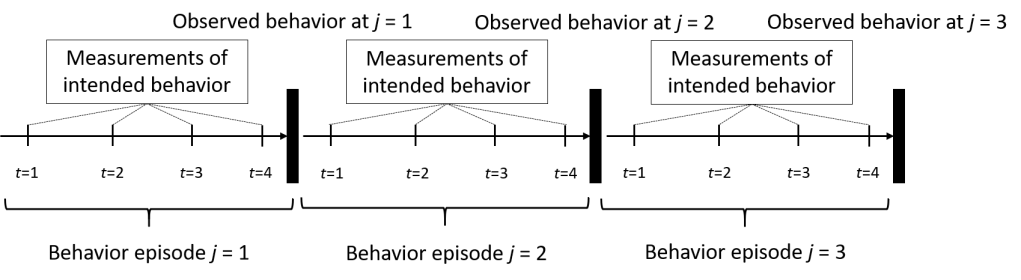
Behavioral Episodes: To thoroughly understand the IBG, studies should include multiple behavioral episodes. Within each episode, intentions should be measured several times (see Figure 2). This approach allows researchers to examine how intentions evolve and change during a single attempt to perform a behavior, leading to more granular insights.

Figure 2: EMA framework for the analysis of the IBG

Between- and Within-Person Variation: EMA enables the estimation of both between-person and within-person variation. This allows researchers to assess differences between individuals as well as changes within an individual over time, supporting the exploration of all four dimensions of the IBG—persons, time, context, and types of behavior.  

Multilevel Modelling: Quantitative analysis should incorporate multilevel modeling to account for repeated measures within participants, particularly when multiple measurements are taken within a behavioral episode. Multilevel modeling is particularly suitable for investigating the IBG because it can simultaneously account for both between-person and within-person variability, allowing researchers to examine how different factors influence behavior at multiple levels. This approach makes it possible to disentangle individual differences from situational changes, offering a more comprehensive understanding of how intentions evolve over time and across contexts. The use of multilevel regression also allows for the analysis of the influences of all four dimensions of the IBG, such as the impact of time, context, individual differences, and types of behavior.

Mixed Methods Approach

A Mixed Methods Approach combines quantitative and qualitative research techniques to offer a more comprehensive understanding of the IBG. This approach is especially valuable for capturing both measurable aspects of intention-behavior relationships and the underlying reasons behind these behaviors.

Quantitative Insights: Quantitative data, such as those collected through EMA, can provide a detailed picture of how intentions and behaviors change over time. This data allows researchers to identify patterns and trends that might be missed in cross-sectional analyses. Techniques like multilevel modeling and hierarchical linear modeling are particularly useful for examining these types of data.

Qualitative Insights: The qualitative component, often using in-depth interviews or open-ended questions, helps explain the “why” behind the patterns observed in quantitative data. For instance, interviews can reveal personal motivations, perceived barriers, and emotional factors that influence whether or not individuals act on their intentions.

Integration of Data: By integrating quantitative and qualitative insights, the mixed methods approach provides a richer, more holistic understanding of the IBG. It offers not only a snapshot of intention-behavior dynamics but also a deeper exploration of the mechanisms driving these changes.

Contact

Prof. Dr. Darko Jekauc
Professor for Health Education and Sport Psychology,
Karlsruhe Institute of Technology

Email: Darko.Jekauc@kit.edu
Tel: +49 721 608 – 45725